
Unnatural Citation Trajectories: A Bibliometric Case Study of Two Iraqi Editors
A data driven investigation into how editorial power is leveraged to artificially inflate academic metrics

In bibliometric analysis, sudden, extreme deviations in citation trajectories often prompt closer scrutiny to ensure the integrity of the scholarly record. An anonymous tip has led us to review highly concentrated citation patterns surrounding two academics at the University of Anbar in Iraq: Prof. Dr. Thafer Thabit Mohammed and Prof. Dr. Salwan Mahmood Abdulateef.
Between 2022 and 2023, both researchers experienced exponential increases in their citation counts, predominantly driven by a narrow set of publications and journals where one or both held editorial or committee roles. Prior to publication, both authors were contacted for comment. They responded within a few minutes of each other, with highly similar defenses.
Compared to the international paper mills that generate tens of thousands of fraudulent citations, the absolute numbers in this specific network might appear modest. However, the severity of academic manipulation is not measured solely by volume, but by the density of the potential misconduct and the institutional power of the actors involved.
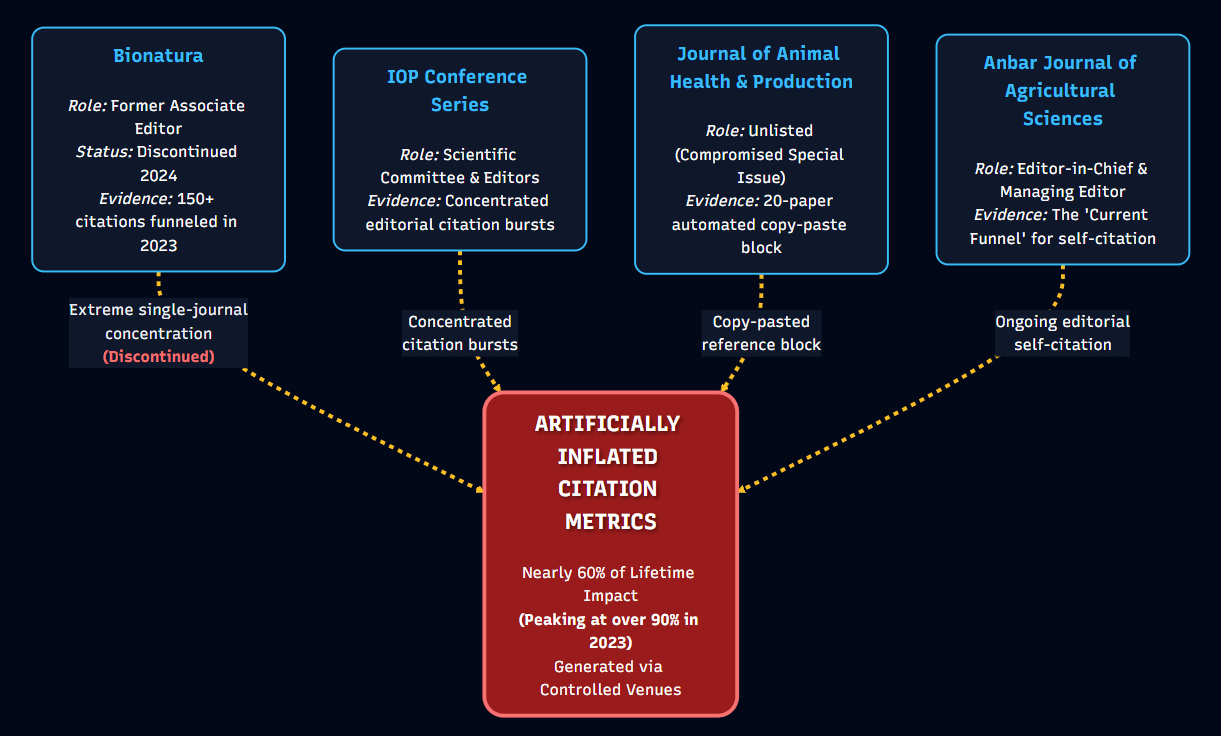
What makes this case significant is that nearly 60% of these researchers’ lifetime academic impact was generated through platforms they directly controlled. Furthermore, these individuals are not junior researchers; they occupy elite administrative and editorial roles at the University of Anbar, including Journal Editorial positions and Chairman of the Advisory Committee for Scientific Publishing. When regional gatekeepers of academic ethics utilize their own journals as personal citation farms, the pattern raises significant concerns regarding the integrity of the local scientific record.
Below is a detailed breakdown of the observed citation anomalies, the authors’ stated defenses, and the factual Scopus data that appears inconsistent with their explanations:
1. The Bionatura Citations
The primary engine of the 2023 citation increase was the journal Bionatura (which was officially discontinued from Scopus coverage in June 2024).
In 2022, Dr. Abdulateef had gathered 20 citations total. In 2023, this number jumped to 150 citations from 121 papers. Of the 121 papers that cited him that year, 99 were published in Bionatura. During this period, Dr. Abdulateef served as an Associate Editor for the journal.
Dr. Mohammed experienced an even steeper trajectory, jumping from 38 citations in 2022 to 261 in 2023 from a total of 186 papers. 150 of those citations originated exclusively from papers published in Bionatura!
The Defense: Dr. Abdulateef claimed the spike was organic, driven by self-promotion, and that his editorial role was restricted:
“The citations did not originate exclusively from a single journal, and the increase coincided with a period during which I actively disseminated my published work through academic communication channels and professional social media platforms in order to increase research visibility and accessibility”
Dr. Mohammed offered a strange defense. Despite never being asked about his own editorial status at Bionatura in the press inquiry, he responded:
“With respect to the citations originating from papers published in Bionatura, I have never participated in the editorial handling of manuscripts with the objective of promoting citations to my own work. Authors determine their references independently”
Such an extreme concentration within a single journal appears inconsistent with the broad citation distribution one would normally expect from increased research visibility alone. Furthermore, Dr. Mohammed’s unprompted denial of “editorial handling” regarding a journal where he held no title could suggest that Dr. Abdulateef, the actual editor, was involved in drafting both responses. It does not explain how Dr. Mohammed managed to get 150 papers out of 186 to cite him from a journal overseen by his co-author.
2. The “Colleague” Defense
Despite the massive overlap in their Bionatura citation sources and the fact that they replied to the press inquiry within a few minutes of each other, both researchers attempted to distance themselves from one another in their emails.
The Defense: In their separate responses, both researchers used nearly identical language to deny a close working relationship.
Dr. Abdulateef:
“Regarding the reference to Prof. Dr. Thafer Thabit Mohammed as my “colleague,” I respectfully question the basis upon which this characterization was made... Academic researchers frequently work within the same institutions... without any involvement in each other’s citation practices”
Dr. Mohammed:
“Your message also refers to Prof. Dr. Salwan Mahmood Abdulateef as my colleague. I would appreciate clarification regarding the criteria used to establish this relationship...”
According to their public Scopus profiles, Dr. Abdulateef and Dr. Mohammed are frequent research partners who have co-authored at least 18 published papers together. That is almost 50% of their total published papers individually. This includes recent publications such as “Indices of Serum Biochemical of Broiler Fed Diet Containing Local Broiler Premix as an Alternative to Commercial Broiler Premix” which was published on 31/12/2025. Downplaying this extensive, ongoing co-authorship obscures the fact that a citation directed to one of their joint papers simultaneously inflates the h-index of both individuals.
3. The IOP Conference Series
Both academics received a highly concentrated burst of citations from the IOP Conference Series: Earth and Environmental Science. Specifically, from Volume 1252, Dr. Mohammed received 23 citations, and Dr. Abdulateef received 9.
The Defense: Dr. Abdulateef claimed they had no editorial control over the volume.
“My role was limited to being one scientific committee member among 24 committee members. I was neither the volume editor nor the editor-in-chief responsible for the proceedings”
Dr. Abdulateef drastically understates their authority.
For Volume 1252, Dr. Mohammed served as the Head of the Scientific Committee, while Dr. Abdulateef was a scientific committee member.
Furthermore, their ongoing control over this specific conference is revealed in a subsequent volume (Volume 1449, published in 2025), where Dr. Abdulateef and Dr. Mohammed are explicitly listed as the Editor and Co-Editor-in-Chief-ICCMAT-2024 of the official “PREFACE: International Collaborative Conference of Modern Agricultural Technologies-2024 (ICCMAT-2024)”. This suggests a substantive role in organizing or shaping the proceedings, which may be relevant to assessing editorial influenceand the claim that they were merely background participants.
4. The Journal of Animal Health and Production
A highly unusual citation pattern appears in the Journal of Animal Health and Production (Volume 13, Special Issue 1, 2025). Within this single special issue, 13 independent papers cited Dr. Abdulateef, and those same 13 papers also cited Dr. Mohammed.
The Defense: Dr. Abdulateef firmly denied any manipulation and pointed to a specific paper to explain the citations:
“The citations referenced appear to originate from a single published article of mine entitled: “The impact of adding Raphanus sativus seeds to the diet of broiler breeders...” I had no involvement in the journal’s editorial processes... Therefore, the existence of citations from this journal cannot reasonably be interpreted as evidence of editorial influence”
Dr. Abdulateef’s defense inadvertently highlights the core conflict of interest. The Raphanus sativus paper he claims was cited organically was actually co-authored by Dr. Mohammed, the colleague he previously claimed a distant working relationship with. In addition to that, the paper was not published externally, it was published in the Anbar Journal of Agricultural Sciences, the journal where both of them currently serve as Editors.
But a deeper bibliometric review of these 13 papers demonstrates that these citations were not generated individually. They are part of a static, repeating block of references.
An analysis of the reference lists reveals a systemic structural anomaly. Regardless of the actual subject matter, 12 of the 13 papers contain an identical, perfectly alphabetized block of over 20 citations. This block consistently begins with the Raphanus sativus paper co-authored by Dr. Abdulateef and Dr. Mohammed, which introduces a heavily concentrated list of papers from a small, recurring network of authors.
A notable indicator of possible indiscriminate or template-based referencing is the inclusion of a computer science paper by Govindarajan S. and Mustafa MA. In 12 out of the 13 reference lists in this special issue, this exact citation is listed as:
“Govindarajan S, Mustafa MA, Kiyosov S, Duong ND, Raju MN, Gola KK (2023). Retracted: An optimization-based feature extraction and machine learning techniques for named entity identification.”
The word “Retracted:” is printed directly within the citation text across 12 different manuscripts.
The following 20 citations appear as an aggressively duplicated, alphabetized block cited in the reference lists of the papers published in the Journal of Animal Health and Production (Volume 13, Special Issue 1, 2025). With 19 of these papers appearing in 12 out of the 13 manuscripts analyzed.

Dr. Abdulateef claims these citations cannot be interpreted as evidence of editorial influence. There is no public documentation linking them to it, as the editorial team on the Iraqi side is not published. However, the exact duplication of an alphabetized, 20-paper reference block, one that forces a retracted computer science paper into unrelated manuscripts is consistent with a coordinated, artificial inflation of citations rather than organic academic discovery.
5. Current Risk: The Anbar Journal of Agricultural Sciences
With Bionatura discontinued, recent data shows a new citation funnel emerging in the Anbar Journal of Agricultural Sciences, where Dr. Mohammed serves as Editor-in-Chief and Dr. Abdulateef serves as Managing Editor. Both editors are actively publishing their own co-authored papers in their own journal, which are accumulating citations from authors submitting to the same journal or the Iop Conference Series Earth and Environmental Science 1449(1), or the Journal of Animal Health and Production special issue 1.
The Defense: Dr. Abdulateef firmly denied any manipulation within his current journal.
“I encourage you to review the journal itself and examine the articles published during 2025... To my knowledge, there is no pattern demonstrating that authors are being directed or pressured to cite my work... within the journal”
A review of the Anbar Journal data confirms that submitting authors are citing the Editor-in-Chief and Managing Editor. For example, a 2024 paper authored by Farhan et al. contains 11 citations directing back to them, and similar citations appear in 2025 papers by Marzouq and others.
Their co-authored 2024 paper (Raphanus sativus) published in their own journal has already accrued 16 citations.
While the authors argue these citations are organic, the heavy concentration of references overlapping directly with the authors’ editorial board appointments raises ongoing questions regarding the enforcement of editorial conflict-of-interest policies; and whether Anbar Journal of Agricultural Sciences is going to follow the same footsteps of Bionatura and get discontinued from Scopus indexing.
6. The “Whataboutism” Defense
When confronted with highly concentrated citation clusters within platforms they oversee, the authors attempted to deflect focus by pointing out that other researchers also received citations in these venues.
The Defense: Dr. Abdulateef argued that narrowing the focus to his profile was inherently misleading:
“If one reviews the journal content broadly, it becomes clear that many researchers from different institutions received citations during the same period. Selectively highlighting particular names without demonstrating direct evidence of coordination risks producing misleading conclusions”
The presence of other researchers in a compromised journal does not validate the integrity of the journal; it merely illustrates the scale of the issue. A bibliometric analysis of targeted, coordinated citation rings relies on analyzing the concentration of an individual’s metrics. The bibliometric patterns observed are difficult to explain through ordinary citation behavior alone:
Of Dr. Mohammed’s 488 lifetime citations, 272 (55.7%) originate exclusively from a closed loop of five venues where he or his frequent co-author held editorial or committee influence (Bionatura, IOP Conference Series, Anbar Journal of Agricultural Sciences, Journal of Animal Health and Production), peaking at ~94% in 2023.
Of Dr. Abdulateef’s 287 lifetime citations, 172 (59.9%), peaking at 90% in 2023 stem from this exact same network of controlled venues.
This degree of concentration raises questions about whether the observed citation patterns reflect organic scholarly influence.
7. The “Lack of Sanctions” Defense
Despite the overwhelming, statistically improbable concentration of citations flowing from journals where these academics wield editorial or committee influence, the authors maintain their absolute innocence based on a lack of institutional discipline.
The Defense: Dr. Abdulateef pointed to the absence of formal sanctions as definitive proof that no manipulation has occurred:
“I also note that no formal investigation, warning, sanction, retraction, or editorial action regarding citation manipulation has ever been issued against me by Scopus, Elsevier, IOP Publishing, COPE, or any publisher or indexing body with which I have worked”
The absence of a sanction is not the absence of misconduct. It is often merely a reflection of the slow pace of institutional justice. Bionatura operated for years as a highly compromised journal before Scopus finally removed it from its index in mid-2024. The data trail left by Dr. Abdulateef and Dr. Mohammed across Bionatura, the IOP Conference Series, and the Anbar Journal of Agricultural Sciences is permanently etched in the Scopus database, waiting for those very institutions to catch up. The citation data remain part of the public bibliometric record and can be independently examined.
8. The “Smoking Gun” Fallacy
Throughout their responses, both authors insist that statistical anomalies in citation data cannot be considered evidence of manipulation unless accompanied by leaked internal communications.
The Defense: Both researchers argued that bibliometric analysis is invalid without a paper trail of explicit coercion.
Dr. Mohammed stated:
“Concerns regarding citation manipulation should be supported by concrete evidence demonstrating coercive practices, such as documented instructions to authors, reviewer comments... or other verifiable records”
Dr. Abdulateef stated:
“Citation clustering, by itself, is not recognized as proof of misconduct without accompanying evidence of coercive editorial behavior, documented communication, or verified editorial malpractice”
This defense attempts to set an impossible standard of proof for independent watchdogs by demanding access to confidential publisher communications. However, modern academic forensics relies on statistical probability. Coordinated citation rings and paper mills rarely leave a trail of explicit, written instructions commanding authors to commit fraud. Instead, they operate through compromised peer-review networks and editorial gatekeeping.
The absence of a leaked email does not invalidate the mathematical certainty of the data. When two academics, who have co-authored 18 papers together, suddenly harvest nearly 60% of their lifetime academic impact from a closed loop of journals where they simultaneously hold editorial and committee power, the combination of these patterns appears highly unusual and would be difficult to attribute to chance alone.