
Scrutiny Without Consequence: The Hollow Reform of Iraqi Higher Education
The Ministry has begun categorizing journals by "risk", adopting the language of its critics. But without holding powerful academics accountable, these new metrics are just administrative theater.

After months of relentless scrutiny exposing citation rings, coerced publishing, and paper mills that fabricated careers within Iraqi academia, the Ministry of Higher Education and Scientific Research has finally blinked. In an apparent attempt to signal reform, the Deputy Office for Scientific Research Affairs has begun circulating detailed audits of Iraqi scientific journals. The new data sent to us via our mail, categorizes 50 journals based on bibliometric indicators, flagging them with risk levels ranging from “Low” to “Critical”. Crucially, the Ministry has adopted a new metric for this audit: the “Closed Loop Journal %”.
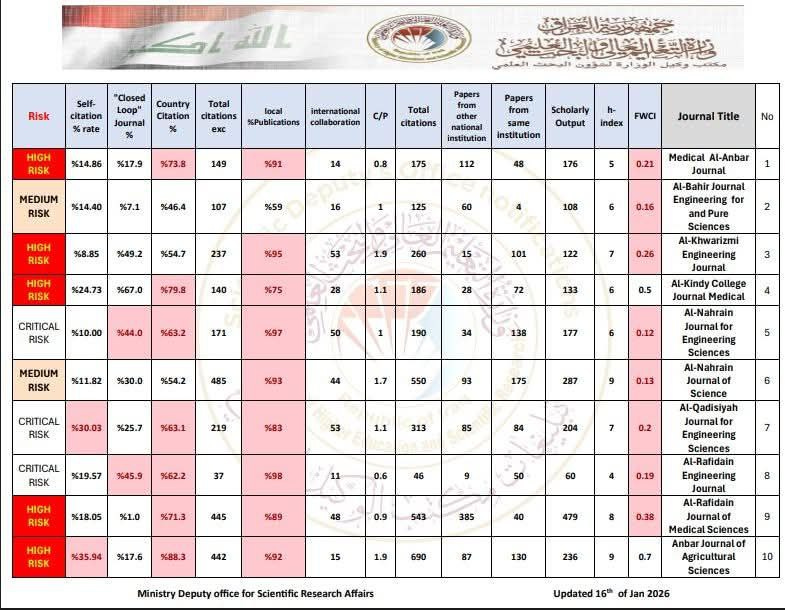
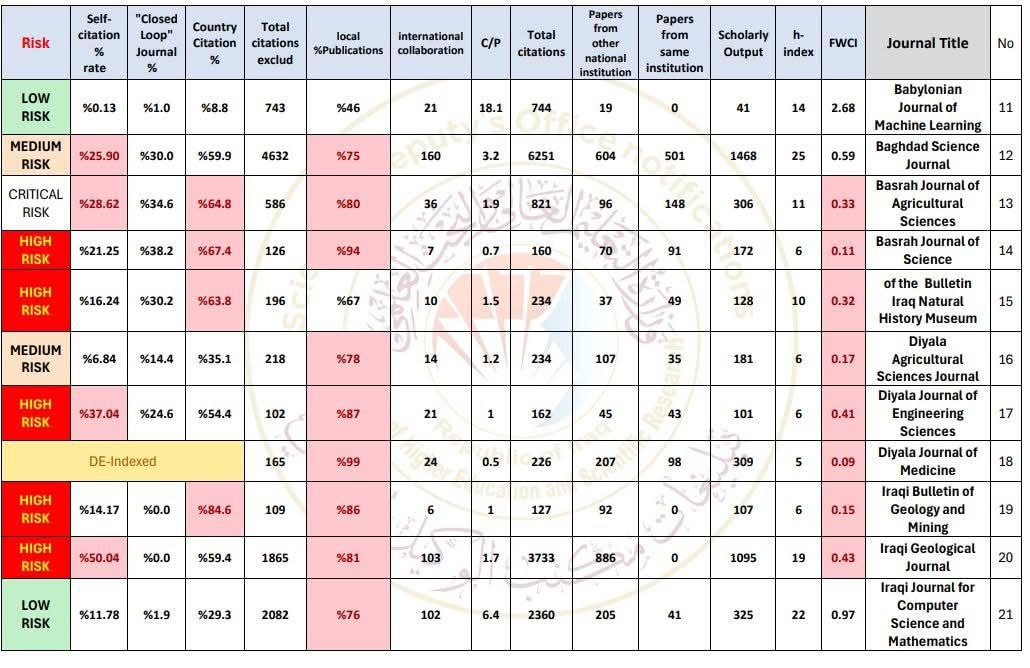
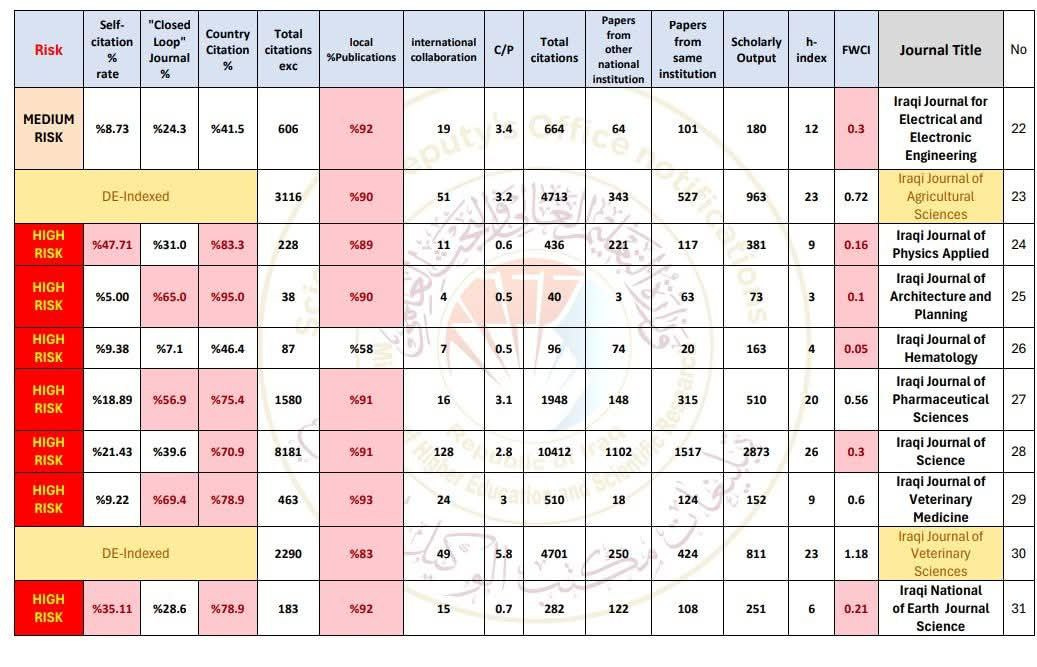
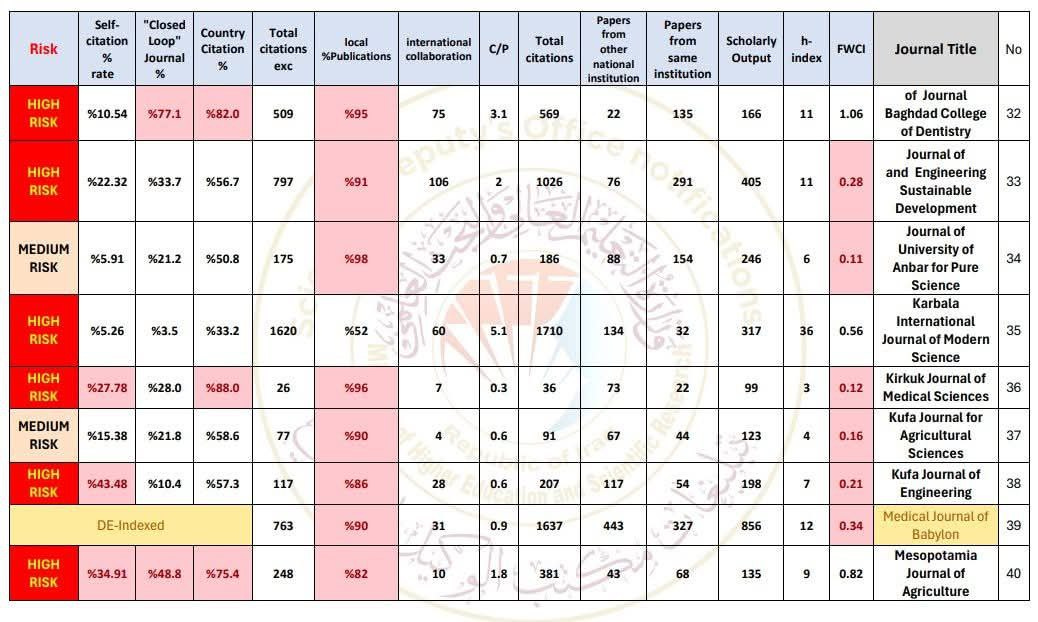
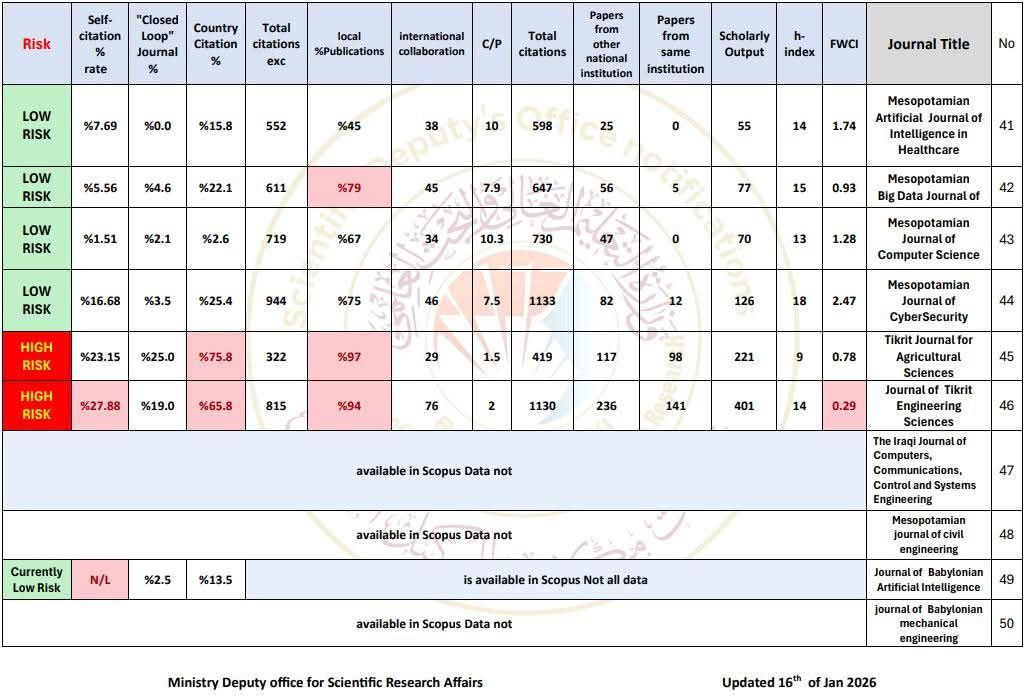
This term appears to be a direct acknowledgment of our investigative work on the Iraqi Journal of Veterinary Sciences, where we pointed out that 75% of citations from University of Mosul authors occurred within papers published inside the same journal.
On the surface, this looks like progress. It looks like the Ministry is finally using data to identify the rot in the system. But do not be fooled by the spreadsheets yet. Scrutiny without accountability is just noise. And in Iraq, the loudest noise is currently coming from the silence surrounding the men responsible for this crisis. The Ministry is attempting to treat the symptoms: the inflated metrics, While actively protecting the disease: the celebrated academics who built their careers on misconduct. Here is the reality of the so-called “reform”: The offenders have been identified, exposed, and in some cases, have confessed. Yet, one by one, they remain in power.
The most staggering obstacle to genuine reform is that the people tasked with cleaning up Iraqi academia are often the ones who dirtied it in the first place.
Take Alaa Al-Charakh, the Chief Editorial Adviser of the Medical Journal of Babylon. He was called out by Retraction Watch on October 17, 2025 for leaked email showing coercive citation. He publicly admitted on Facebook to a coercive citation scheme, forcing authors to cite his journal and his own papers to get published. Despite the journal being delisted from Scopus and his confession being a matter of public record, Al-Charakh remains in his position. No accountability, No Penalty and No statement from the journal, University or the Ministry. Al-charakh however, started publishing his own unhinged posts on Facebook, threatening whistleblowers and using homophobic names.
The rot extends to the University of Mosul, where Yasser Fakri Mustafa still serves as the Dean of the College of Pharmacy after he amassed 17 retractions linked to authorship manipulation and paper mills. Yet, he remains the Editor-in-Chief of the Iraqi Journal of Pharmacy, and in the Editorial board of Mosul Journal of Nursing. While international bodies are taking action: Springer Nature recently removed him from an editorial role for a "Coumarins" collection after being called out by @Spottingthespot on X. his local institution remains silent. He even lists editorial board memberships on his ORCID for journals like Eurasian Chemical Communications that have seemingly scrubbed his name from their Editorial Boards. He is losing credibility abroad but keeping his power at home. No accountability, No Penalty and No statement at his local environment.
Even higher up the chain, the conflict of interest becomes clearer. Following the Babylon scandal, the office of Dr. Haider A. Dhahad, Iraq’s Deputy Minister for Scientific Research Affairs, issued an “Urgent Directive” ordering journals to stop “exaggerated self-citation”. Yet, Dr. Dhahad himself has had at least six of his own papers retracted due to signs of paper mill involvement, authorship changes, and citation irregularities. He is currently overseeing the very “risk assessments” meant to clean up the system, despite having a retraction record worse than many of the researchers he is policing. It is the ultimate case of a fox guarding the hen house… Again. No accountability, No Penalty and No statement.
If you want to know what a system truly values, don’t look at its memos; look at who it rewards. In October 2025, the Ministry celebrated “Iraqi Science Day”, filling the stage with researchers whose careers are testaments to metric gaming. They awarded Dr. Qusay Hassan of the University of Diyala as a “Distinguished Researcher”, despite him holding over 20 retractions linked to known paper-mill broker Marek Jaszczur.
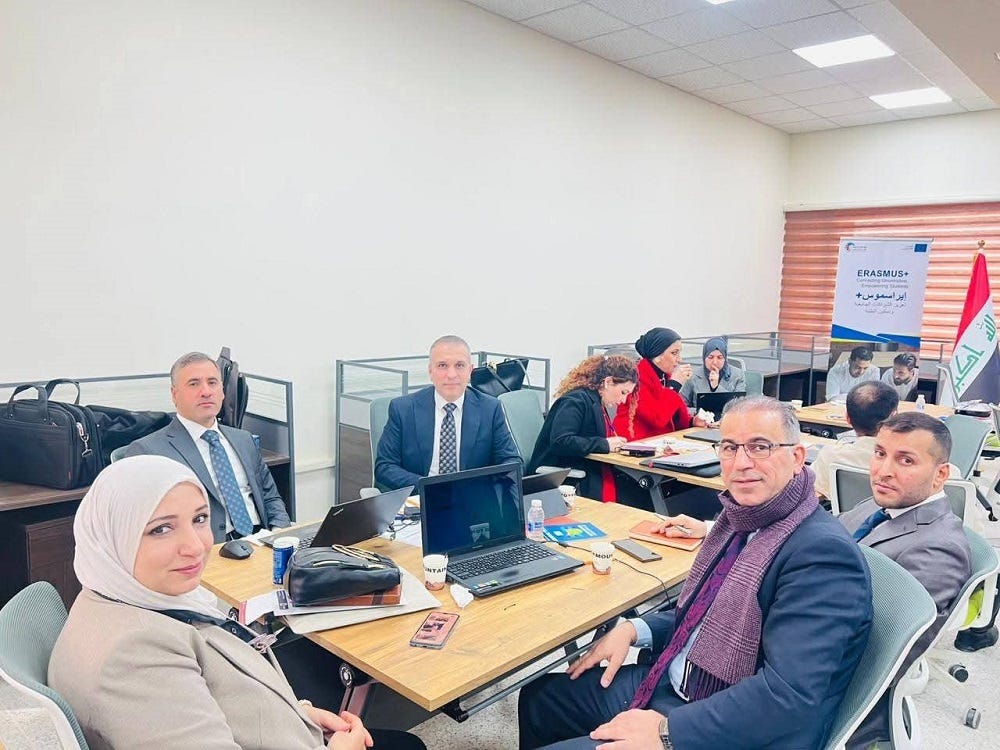
The disconnect between the Ministry’s rhetoric and its actions was on full display just three weeks ago. On January 3, 2026, the University of Diyala sent a delegation to an Erasmus+ workshop on “Capacity Building” and “International Standards”, funded by the EU. Their representative was none other than Dr. Qusay Hassan himself. While the Ministry circulates spreadsheets about “risk”, they are simultaneously allowing a man with a documented history of fraud to represent Iraq in prestigious international partnerships. Not only Dr. Qusay Hassan remains in his position, but he got No accountability, No Penalty and there was No statement regarding his actions.
The pattern of rewarding fraud continues with Zainab T. Al-Sharify. Her family ran an AIP conference volume like a private printing press, publishing 27 papers in a single issue and mixing irrelevant topics like walnut shells and 5G technology, just to farm citations. Despite this, she was awarded “Distinguished Researcher” at Science Day. Today, Zainab and her brother Mushtaq Talib Al-Sharify remain editors for the Tikrit Journal of Engineering Sciences. No accountability, No Penalty and No statement.
She’s also an editor for Iraqi Journal of Chemical and Petroleum Engineering, Journal of Petroleum Research and Studies, and International Journal of Environmental Studies (JES).
Furthermore, it is important to point out that Elsevier, the publisher of Scopus sponsored the AUIQ Awards, which honored the exact same slate of repeat offenders, including Qusay Hassan. The award criteria were explicitly designed to allow retractions, giving hyper-prolific fraudsters a pass. Elsevier continues to sell its analytics products to the very Ministry gaming them.
When fraud is exposed, the instinct of Iraqi university administrations is not to investigate, but to defend. When we exposed that undergraduate student Adam Nasser posed as “Dr. Nasser” to peer-review for a Wiley journal, the journal labeled him an “imposter” and threatened legal action. Yet, the response from Al-Mustaqbal University was shockingly defiant. The Director of Scientific Affairs claimed they had “verified” his accounts, and the Dean gave him a formal letter of thanks. The Dean and Director who validated this fraud remain in their posts, having doubled down rather than admit a failure of oversight. No accountability, No Penalty and No statement.
Finally, we must remember that this crisis was not accidental; it was policy. As our release of leaked internal documents proved, for years, major institutions like the University of Baghdad, Mustansiriyah University, and the University of Technology explicitly mandated coercive citation. They issued official orders requiring graduate students and faculty to cite a minimum number of papers from their own universities or faculty members as a condition for graduation or promotion. The corruption was institutionalized. Even though other universities have no leaked specific documents, patterns point to the same behavior as the case in Iraqi Journal of Veterinary Sciences which has been recently discontinued from Scopus. The very department heads and deans who enforced these coercive policies for years are now expected to implement the Ministry’s new “reform” agenda.
The scope of this investigation extends significantly beyond the examples provided here. For every name exposed in this report, a dozen others continue to operate comfortably within the system, protected by institutional silence. However, we are no longer relying solely on manual review. We are currently beta testing the FraudFactor Index, a forensic Calculator designed to benchmark research output. This tool mathematically distinguishes between high-impact researchers and those manipulating metrics. We possess the data, and soon, we will launch the calculator, the audit is far from over.
Conclusion: Administrative Theater
The Ministry of Higher Education’s new journal risk tables are a sophisticated piece of administrative theater. They allow officials to point to complex data and claim they are “studying the problem”.
But data is not action.
A “Critical Risk” label on a journal means nothing if the Editor-in-Chief who rigged the citations keeps his job. No accountability.
A “Closed Loop” metric means nothing if the Deans who mandated those loops are never sanctioned. No statement.
And a “Reform” agenda means nothing if it is led by a Deputy Minister with six retractions on his own record. No Penalty.
For Iraqi higher education to rejoin the global scientific community, it doesn’t need more spreadsheets. It needs to break the silence. Until the architects of this fraud are removed from their positions of power, any attempt at reform is just paperwork designed to hide the rot.