
RI² Updated: 18 Iraqi Universities are Under the Lens of Research Integrity
RI² uses delisting, retractions, and self-citations to flag vulnerabilities in Iraq’s research ecosystem

What’s New in RI² (September 2025)
Lokman Meho, the project’s founder, highlights several key enhancements:
Three risk components instead of two:
D-Rate (Delisted Journal Risk)
R-Rate (Retraction Risk)
S-Rate (Self-Citation Risk) → newly added
Expanded coverage: 2,000 of the world’s most publishing universities, up from 1,500.
Field-based grouping: Universities are now classified into Medical & Health Sciences, Multidisciplinary, and STEM for fairer comparisons.
Field-normalized scores: Each metric is normalized and winsorized at the 99th percentile to reduce distortion from extreme outliers.
No institutional rankings: RI² emphasizes integrity assessment rather than competitive ranking.
Peer-reviewed validation: The methodology has been strengthened through referee, journalist, and community feedback and is under final review for publication.
And as Meho emphasizes: “RI² is designed to highlight vulnerabilities in research integrity, not to compete with QS, THE, or other performance-based rankings”.
Baghdad’s Rise: The Role of Self-Citation
The newly added self-citation metric (S-Rate) has reshaped Iraq’s RI² landscape. Looking at the top Iraqi universities by RI² score:
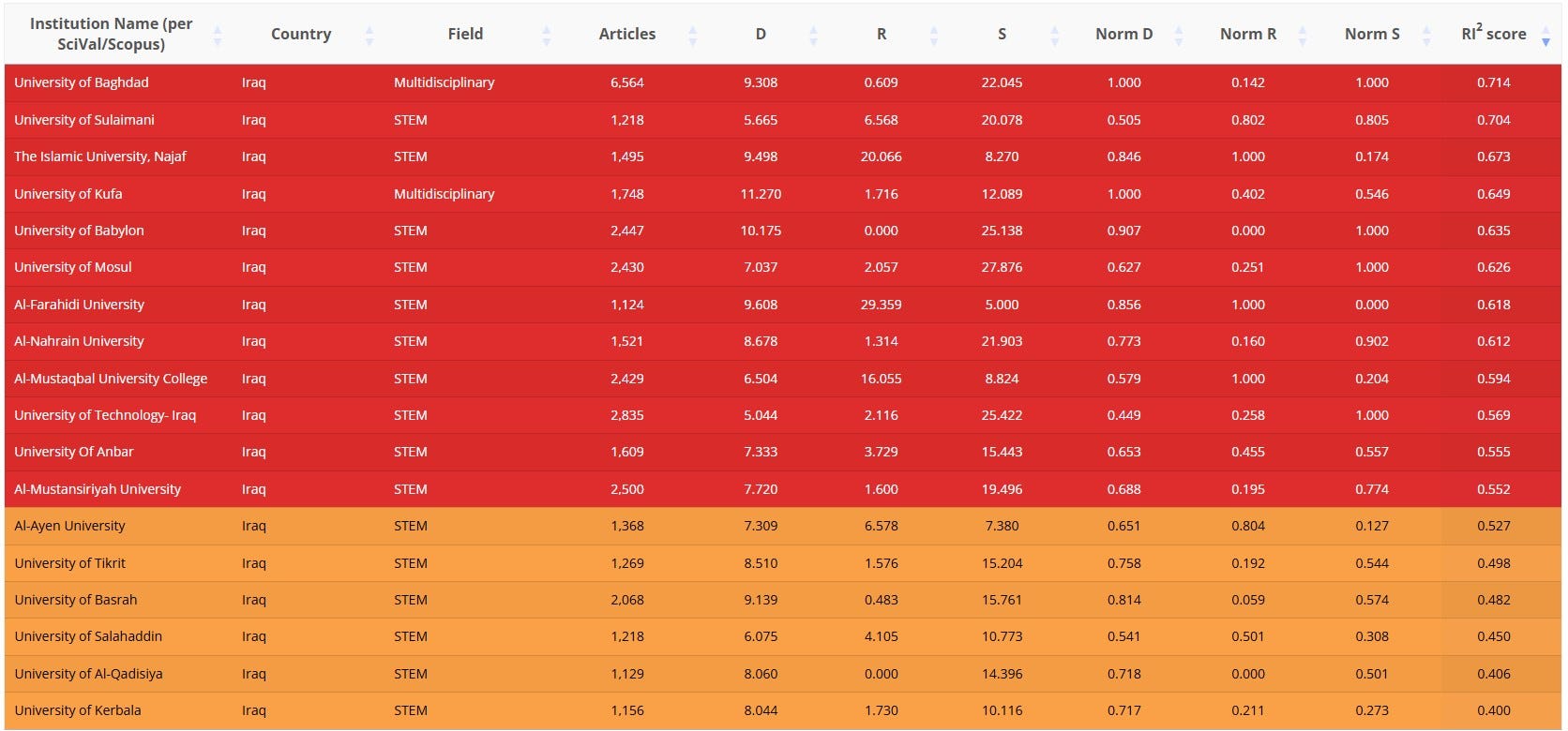
Key insights:
Baghdad University tops the RI² score (0.714) not because of the highest self-citation (Mosul and Technology–Iraq are higher) but due to a combination of delistings, retractions, and elevated self-citation, showing the interplay of the three metrics.
Al-Mustaqbal University College, with extreme retractions (16.055) but lower self-citation (8.824), ranks lower at 0.594, illustrating how multiple factors affect RI².
The Iraqi Journal of Agricultural Sciences (IJAS) exemplifies this pattern: forced self-citation practices likely contributed to anomalies, leading to its delisting from Scopus and Clarivate. Be sure to check out our previous story titled (Q1 "Iraqi Journal of Agricultural Sciences" Removed from Scopus) for more details about this journal.
This demonstrates that self-citation is now a major integrity signal, and its incorporation has reshuffled Iraq’s institutional standings.
Winners and Losers in Iraq
University of Baghdad rises to first nationally, overtaking Al-Mustaqbal University College.
Red-flagged universities (extreme anomalies): University of Sulaimani, Islamic University of Najaf, Al-Farahidi, Al-Nahrain, University of Anbar.
Orange zone (watch list): Al-Ayen, Tikrit, Salahaddin, Al-Qadisiya, Kerbala.
University of Basrah improved from red to orange.
At the country level, Iraq slipped from first to second globally, overtaken by Jordan. Saudi Arabia and Bangladesh improved into lower-risk zones.
Defensive Reactions vs. Constructive Engagement
When Iraqi universities first appeared in RI² earlier this year, government responses were defensive and dismissive:
Officials claimed RI² was “unofficial” and damaging.
Comparisons to QS rankings were used to downplay integrity concerns.
But such arguments overlook the purpose of RI²:
Every major metric or ranking began unofficially (QS, Scopus, h-index).
RI² relies on hard bibliometric data: delistings, retractions, self-citation. Not opinions.
Ignoring RI² does nothing to address systemic issues in publishing.
Lessons for Iraq
Audit institutional publishing practices to detect anomalies.
End forced self-citation policies, ensuring citations reflect genuine scholarship.
Revise promotion and funding criteria to prioritize quality over quantity.
Establish national oversight bodies to monitor integrity risks.
Engage constructively with RI², correcting errors where found but using the data to drive reform.
Conclusion
The latest RI² update doubles Iraq’s presence in the index and places Baghdad University at the top of the national risk list. This is not a mark of honor, it reflects metric manipulation and systemic vulnerabilities highlighted by forced self-citation and delistings such as IJAS.
RI² is not an enemy of Iraqi higher education. It is a diagnostic mirror. The choice is clear: acknowledge the warning, fix the system, and restore credibility or continue eroding Iraq’s research reputation.
RI² doesn’t attack universities, it gives them a chance to save themselves.
Sources
https://www.linkedin.com/posts/lokman-meho-72441131_ri2-activity-7374530564063641601-Vetv
https://sites.aub.edu.lb/lmeho/ri2
Another lesson for (or also from?) Iraq:
6. Foster a grass root movement of like-minded academics, or whoever folks who know the issue inside out in the same country. The Indian Research Watch in X is an excellent example, as well Dissernet of Russia in the past (before Vladimir Vladimirovich did the crackdown). Spread the awareness and teach more folks to be sleuths.