
Author Pushes Back on Retraction Watch Allegations. Does His Defense Hold?

Introduction
Yasser Fakri Mustafa, professor of pharmaceutical chemistry, dean of the College of Pharmacy at the University of Mosul, and editor-in-chief of the Iraqi Journal of Pharmacy, has emerged as one of Iraq’s most prolific scientists. With more than 500 publications to his name, including hundreds indexed in Scopus and Clarivate’s Web of Science, he has positioned himself as a highly visible figure in Iraqi academia. His publication record is especially notable for its surge after 2020, peaking at 120 articles in 2022, much of it in Q1-ranked journals.
But this visibility has come at a cost.
Since 2022, Mustafa has amassed at least 16 retractions from major publishers such as Elsevier, Springer Nature, MDPI, Taylor & Francis, Wiley, and Frontiers. The charges range from authorship manipulation and undeclared conflicts of interest to the inability to produce raw data or valid ethics approvals. His name has also appeared in investigations into paper mills, particularly those linked to “authorship for sale” Ads.
The growing number of retractions raised many questions about both Mustafa’s publication practices and the academic integrity and environment in Iraq.
The Allegations
A recent Retraction Watch article documented the mounting concerns:
Authorship manipulation: Cases where Mustafa and others were added to papers during revisions, sometimes in connection with authorship Ads on social media.
Peer review irregularities: Instances where reviewers with conflicts of interest contributed to manuscripts without disclosure.
Lack of data and ethics approvals: Journals reported that data were unavailable upon request and that ethics approvals were duplicated or unverifiable.
Link to paper mills: Independent sleuths connected some of Mustafa’s publications to “authorship for sale” operations, particularly one with ties to Latvia.
His coauthors on retracted works include influential Iraqi academics, including former university presidents and a current head of Iraq’s Scientific Research Commission.
While journals such as Elsevier and Springer Nature described clear breaches of ethical practice, Mustafa and Iraqi higher education officials have framed the issues differently.
Mustafa’s Response
In a lengthy reply posted to Retraction Watch, Mustafa argued that the retractions stemmed primarily from procedural or administrative issues rather than misconduct. He emphasized several points:
Distinction between misconduct and procedural lapses – He claimed most retractions were related to author order, misunderstandings around ethics approval numbers, or editorial technicalities rather than data falsification, plagiarism, or fraud.
A record of Q1 publications – Mustafa highlighted his hundreds of articles in top-ranked journals as evidence of scientific rigor and impact.
Context of Mosul’s wartime disruption – He attributed his earlier low output (2008–2019) to the devastation of war and argued that his sudden surge in productivity after 2020 was a natural rebound once stability and institutional infrastructure returned.
Collaborative responsibility – He stated that in many of the retracted papers, his role was limited to revising manuscripts for style and journal compliance, not generating or analyzing data.
Bias and targeting – Mustafa questioned why he had become the focus of investigative scrutiny, suggesting potential bias or vendetta, and threatened legal action against journalists for reputational harm.
Does His Defense Hold?
Mustafa’s response raises important contextual considerations but leaves critical questions unresolved:
Procedural vs. substantive breaches: While some retractions might be attributable to administrative issues, journals like Elsevier and Springer Nature explicitly cited conflicts of interest, lack of ethics approvals, and missing data — issues that go beyond “author order” and suggest deeper integrity concerns.
Volume and pattern: Even if some retractions were minor, the sheer number — 16 and counting, with more investigations ongoing — indicates a pattern rather than isolated oversights.
Surge in productivity: Mustafa’s explanation that Mosul’s war conditions suppressed research until 2020 is plausible. Yet producing 120 papers in one year is unusually high for a single researcher, raising legitimate doubts about reliance on paper mills, excessive co-authorship, or “guest authorship” practices.
Deflection of responsibility: His claim that he merely “revised manuscripts” conflicts with retraction notices that directly implicated him in authorship manipulation and failure to provide data. Even if he played an editorial role, attaching his name implies shared accountability.
Bias argument: Suggesting personal targeting does not address the substance of the evidence — the documented retraction notices and flagged publications.
Recognition at Home
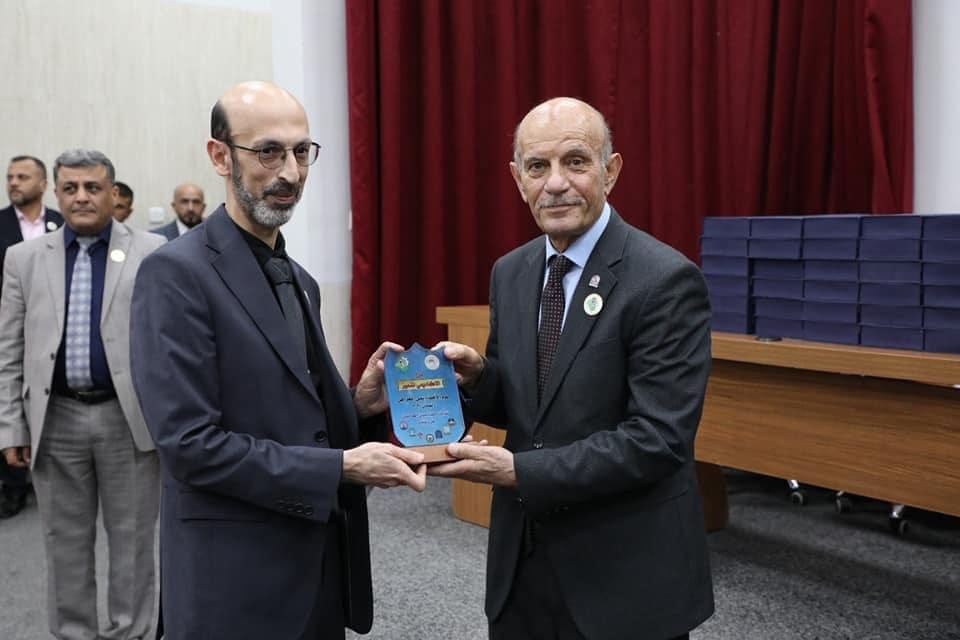
Mustafa’s situation becomes even more striking when looking at how he was viewed inside Iraq compared to abroad. On April 4, 2022, when the Retraction Watch Database already showed 11 retractions out of his eventual 17, he was honored at the “Distinguished Academic Day” celebration in Mosul.
The Iraqi Academics Syndicate in Nineveh, with support from Al-Noor University, gave him the “Distinguished Academic Shield” (درع الأكاديمي المتميز). The award recognized him as the most-published faculty member at the University of Mosul and the holder of the university’s highest h-index.
The ceremony was attended by senior officials, including the Iraqi Prime Minister’s advisor for the reconstruction of Nineveh, university presidents, and deans. The citation praised Mustafa for his “outstanding efforts in scientific research and for strengthening academic leadership in the field of pharmacy.”
That he was collecting retractions internationally while being celebrated locally shows a sharp difference in priorities: international publishers focused on integrity and ethics, while local recognition emphasized publication numbers and research visibility.
Conclusion
The case of Yasser Fakri Mustafa embodies the tension between scientific ambition, systemic academic pressures, and the integrity of global publishing. His defense highlights the real hardships of Iraqi academia, which endured years of war and institutional collapse, but it sidesteps core issues raised in the retraction notices.
While Mustafa presents himself as a victim of procedural misunderstandings and biased scrutiny, the weight of evidence from multiple independent publishers suggests repeated breaches of research integrity. Whether these are the result of deliberate misconduct, opportunistic co-authorship practices, or systemic dysfunction in Iraq’s academic environment remains an open question.
Mustafa’s case highlights the tension between being highly productive and maintaining ethical standards, showing that recognition alone does not guarantee integrity. The fact that he was honored as a “Distinguished Academic” in Iraq while accumulating retractions abroad calls into question the integrity of the academic environment in Iraq, where recognition can still be granted on the basis of numbers rather than ethics.
Sources
https://retractionwatch.com/2025/09/05/yasser-fakri-mustafa-iraq-mosul-university-dean-paper-mills-retractions/
https://retractiondatabase.org/
https://www.facebook.com/share/19ioJzGTUW/